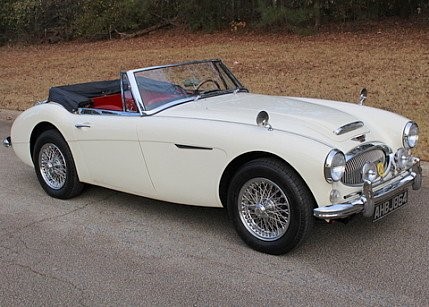
 Racing my white with red leather interior 1967 Austin Healey 3000 Mark III down isolated farm and off-season, deserted, beach roads was glorious. I loved speeding (Is there a statute of limitation on speeding tickets because 120mph to 150mph was a perfect cruising speed?) with the top down, bundled up with the heat of the double carburetor feeding six cylinders of power warming my feet. Just skimming above the road, I could almost touch it. This is the only car I truly loved. Then, that golden moment when the Jaguar pulled up beside me at a red light on a well-traveled, local highway. In true classic drama, first I saw the hood ornament hesitate in my peripheral view before the driver of a British racing green Jaguar pulled up next to me. He made the obligatory scan of my Healy, turned up the corner of his lips in an “I dare you” sort of fashion and nodded in approval while he revved his engine. I gave him an almost unperceivable nod and whispered to my dashboard, “Let’s skin this cat.” No revving noise or bluster from us, as from our competition beside us, just quiet anticipation of a green light. Red went to green. Six cylinders working off twin carburetors on a small frame with a hundred pound driver was no match off the line. A flip of a toggle switch into overdrive ended the competition. The Jaguar was still in my rearview mirror as I approached the traffic ahead. When he came along beside me again, he acknowledged the defeat with a smile and a wave. Never underestimate the power contained in a small package.
Feeling the adrenaline rush through your body as set your vehicle up perfectly between the staging lights. Once your opponent and you are “staged”, the Christmas tree lights blink down to green and you are off! Leave too soon and the red light comes on; race over! You are disqualified. As in any competition, it is about power with control. On the local drag race track, I won my division. But, it wasn’t in a fast sports cars, it was with a long body van. Anticlimactic, huh? It was fun though!
Riding on the back of one our Harleys (I searched for a model low and light enough for me to handle. I voiced my feminist outrage to several salesmen. By the time Harley Davidson began making cycles for 5’2” women, I had kids, bills and responsibilities. A motorcycle was no longer within my grasp. Yeah, they sold tight shirts and earrings but not a thought about females as riders.), riding a Vespa through the hills of Greece, rode my moped from barn to beach, a Jeep without doors or windshields, and bicycling everywhere, I loved my wheels! The faster, the better.
Now, I depend on wheels to get into the bathroom. Different wheels take me into the shower. Another set of wheels are for leaving the house. Another set of wheels for my work desk. Steps are the barriers which keep me out! Ramps and lifts allow me to access the rest of the world I used to take for granted. It is amazing the amount of establishments from doctors to restaurants without handicap access. Worse is, the claim to have access where upon arrival to discover access is a delivery entrance which I must be carried over a portion through a warehouse, kitchen, etc. People are putout having to move furniture or rearrange a display while patrons stare to determine the source of the commotion.
The type wheelchair elicits different reactions. Yes, I would never have imagined how strangers feel compelled to voice their assumptions and opinions about me. My memory does not recall this type of outward criticism prior to my illness. With six and half years in a wheelchair experience, I believe it has to do with power and weakness. Is this a primal response? Or, are there just more brutish people with egoistic attitudes our society has cultivated into a “us and them” mindset? When I was too weak to sit up on my own, I used a motorized wheelchair. When out in public (mostly stores), people would stare me down, make huffing noises because I was in their way (I did take up more personal space in a wheelchair than if I was standing.), cut me off and tell me how I should be walking as they briskly fled away from me. This wasn’t a singular occurrence. This happened nearly every time I went out. Other than work, going to a box store was one of the few weekly events out for me and this was what I encountered there. I stopped going for a while until I rationalized I should pity those terrible people because it was on them and not me.
After several years, I gained enough strength to get an ultralight manual wheelchair (the sports car of wheelchairs). It was as if a switch was flipped! Immediately, the side eyes were gone, frowns changed into sympathetic grins accompanied with words of encouragement or silence. . The only variable to change was the type of wheelchair. The manual wheelchair gave the impression that, I was handicapped not, fat and lazy!
Many people still ignore me. I understand they are at loss of what to say with their best response is to avoid eye contact. It is interesting to watch people give me an exceedingly wide berth as if I may careen out of control at any moment. At work, there is a person who hugs the wall of eight foot wide hallway each time I pass her. The wheelchair also elicits the impression of some that I am mentally diminished, hard of hearing or speaking in condescending tones as if I am a small child.
Remember being among adults as a four or five year old? Weaving through and seeing only legs, looking up to see the faces of the owners of those legs? Sit in a wheelchair for a day and relive the experience. I stay away from large crowds. Concerts where people are standing offers me a view of everyone’s butts. Wheelchairs offer limited views of your surroundings; sometimes I have to remind myself to look up.
My friends took up a collection to fund the deductible the insurance company would pay to allow me to get a new wheelchair. The change to the ultralight wheelchair was an emotional and physical transformation. It took so much more core strength to just, move. Maneuvering over bumps and thresholds, mastering skills to transfer into chairs, restaurant booths and cars! Being free of the huge, double battery six wheeler scared me but was also freeing. The large armrests were gone; I had to keep myself balanced. Powering through obstacles changed to learning how to wheelie over or around them. When the machine was stopped, it was stationary; scissor brakes are double checked to remain motionless. Tire pressure and avoiding running over sharp objects replaced maintenance free solid tires. It is all worth it. I take up a smaller footprint, I can pivot and did I mention? I can ride in the front seat of a car.
Because of the size and weight of a motorized wheelchair, it does not travel well. While I was in the sub acute rehab center, my husband purchased a used van with a wheelchair lift. At the time, I hated the idea because in my mind, I would be up and walking in a year maybe two at worse. I am glad he didn’t listen to me. I rode in the back of the van, holding on to seat belts on every turn for years. On one occasion, my son and his girlfriend were driving the van with me in the back. My son was driving at his usual pace but when taking corners; I had to hold on so tight to prevent my head from hitting the window next to me. His girlfriend quickly became aware of my stress and asked my son to slow down. Although he slowed a bit, I was still swaying in the back. After the girlfriend’s several requests to slow down, she changed tactics. She told him, because my center of gravity in the wheelchair was higher than theirs in the car seats, the force centrifugal force in taking corners was difficult for me to overcome. He got it immediately and slowed down. Did I mention? They are both engineers. Sitting so high in the van felt like I was in a fishbowl. Drivers and passengers in other cars would stare in to see why the person in the back is not sitting in a seat at the normal level. Another problem with the wheelchair lift on the van was the amount of space needed to lower the ramp, load and raise was difficult to find. We had a car run over the end of my lift just as I was about to approach it. The driver saw all that space between the sidewalk and the lift, thought he could fit between the two, never imagining a large motorized wheelchair would be loaded onto it. The driver never stopped; he achieved his goal of getting past another car. Luckily, just the bottom of the lift’s ramp got bent a little, the self absorbed driver didn’t take out the mechanism and he didn’t hit me.
An ultralight wheelchair meant I could move to the front seat of the car! Well, here is something I never thought of: objects come at you very fast in the front seat. For years, I was either lying still, going as fast as my motorized wheelchair would go or sitting high up in the back of a van with a small perspective of the road ahead. The first time in the front seat was terrifying. I gripped the armrests in fear of each car hitting us. The cars next to us were too close; the cars coming towards us seemed to be coming at us. This was just driving around town at speeds no more than forty miles per hour. It took a long time to acclimate to this new perspective. Traveling with an ultralight was quicker and easier. After transferring into the car with a slide board, even my friends could lift the wheelchair into the back of the car and we were on our way!
In 2015, we decided to visit my son and his family in the upper peninsula of Michigan for Thanksgiving. We planned drive for two days with one motel stop. I was fine until we got into traffic surrounded by tractor trailers. From my vantage point in our compact car, all I saw were tires. Doubled up tires, on multiple axles moving buildings on the road next to me. On the edges of the road were remnants of failed tires, tire marks running off the roads, bits of glass and plastic evidence of previous disasters. Claustrophobic, I imagined the low pressure of the tires nearest me with their loads leaning over our small car. I startled easily trying not to gasp at each perceived threat so as not to alarm my husband while driving. By the time we reached Pennsylvania with double and triple trailers heaving up the hills and speeding down the other side, I rode with my eyes closed and my fists clenched. Ohio was just as bad but at least it was flat. The dreaded drive back was remedied by my son who downloaded mediation music onto my phone and purchased headphones for my trip back. Here’s the good news, we’ve drove back to Michigan again and I am cured!
Why don’t I get a handicapped driver’s license and drive myself? This is a dilemma with DMV. The DMV has requirements to obtain a handicap license but no procedures to reverse it. The requirements for a handicap license are expensive. I was quoted a price for the required driver training through a private party at a cost in excess of $2000.00 on their schedule and location. A written and road test is required. The hand controls at the cheapest which consist of two sticks and Velcro cost about $1500.00, with more technical controls reaching up to $5000.00. The insurance company requires I pay equal car insurance although I am not driving because I still possess a legit driver’s license. My right leg is almost up to the task and I have a hope to drive again someday. If acquiring a handicap license is this expensive and difficult, I can only imagine it would be almost impossible to regain my previous driving rights.


 recover4shore